Category: Writing Asides SD

  • How I Learned to Write.
    How I Learned to Write.

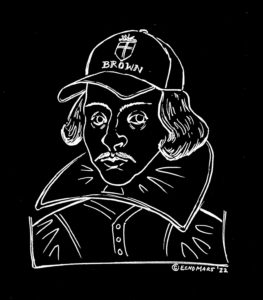
    My father Elmer—a rather odd moniker for a Jewish kid from Pawtucket, Rhode Island—taught Shakespeare at Brown University for almost 40 years. But he could quote Harpo as easily as Hamlet, Philip Marlowe as easily as Christopher Marlowe. A good line was a good line. Provenance had little to do with it. He was an exacting grammarian who would repeatedly remind anyone within earshot that “the reason is because” is redundant…ditto for “proactive,” and that you shouldn’t start a sentence with “hopefully” (no matter what anyone else said). But he also suggested that beginning sentences with conjunctions was permissible if done sparingly; it was OK to occasionally split infinitives and end sentences with prepositions if you needed to. Sentence fragments were also OK. In moderation. If you catch my drift. Rules were meant to be broken but only if you knew you were breaking them and had a damn good reason for doing so. It was more important for you to have command of the language than for it to have command of you.

    Elmer taught me the crucial difference between what I thought my words were saying and what they actually said. In the former, writers really only listen to themselves, leaving the reader to watch from a distance as phrases and sentences careen unchallenged around the writer’s brain, trapped in self-referential loops. In the latter, the writer listens along with the readers. They may not agree. They may not even like each other. But they are at least on the same page.

    In 1967, I wrote an impassioned essay for my high-school paper looking at the brutal massacres of Vietnam citizens in light of the Nuremberg Trials. Elmer agreed with the sentiment, but pointed out that since the piece was riddled with false equivalencies and tenuous logic, it would be hard for the reader to fully appreciate the righteous passion behind it. I stormed away in frustration, of course. Three years later, he tried to convince me to apply the same discipline to a paper I wrote arguing that many biblical visions were drug-induced hallucinations. He suggested that my “brilliant”  insights wouldn’t be taken seriously if I kept jumping to so many equally drug-addled conclusions.

    One of the more misguided flaws of my generation was the assumption—particularly when hallucinogenics were involved—that you had to be there. A reader has never had to be there. Otherwise, there’d be no science fiction. Not to mention One Flew Over the Cuckoo’s Nest. These days, I often think of Elmer when I’m reading emails and texts. It’s a good thing that he shuffled off his mortal coil almost 30 years ago. While he might have considered emoticons a mildly amusing use of keyboard letters and symbols, he would have considered emojis an abomination (one of his favorite words). Even now I can’t use them for fear he’ll come back and smite me. I mean this was a guy who said if you had to use an exclamation point your words weren’t strong enough!!!!! To use a deranged smiley face with sparks flying out of its head would be something up with which he would not put(!)
     

  • Pockets.

    Pockets are a problem. Whoever came up with the idea back in 18th Century England was doing too much snuff. Pockets are especially a problem for writers. Because, in addition to keys, loose change, wallet, eyeglass case, and cell phone, you also need a pad, pen, pencil, glasses, and, of course, a napkin that you’ll throw away even though it has some really good ideas on it. (Not to mention masks. Two years ago it was hard to find one. Now they appear in the pockets of every coat I put on.)
    Admittedly, I make things worse by dressing in layers—an increasing number of layers as it gets colder. So, between jeans, fleece vest, sweatshirt, and the occasional windbreaker, I could be walking around with anywhere from five to ten pockets. And I’m not even counting those weird hidden zippered ones. You put something in one of those and it’s history.

    All those pockets, combined with a barely detectable attention span, mean it’s unlikely I’ll find my phone before the person hangs up, a pen before I remember what I wanted to write, or my keys anytime in the near future. So I end up spending most of my time in public patting myself in ways that many people would find disturbing.

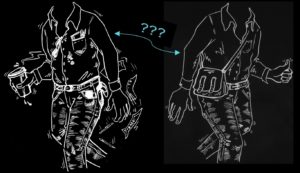
    For several years, my wife Wendy would mildly suggest—and that’s putting it mildly—that I put myself out of my misery by getting a “man bag”. In addition to the phrase’s troubling connotations, I didn’t see how I’d benefit from a public display of pockets. Besides, I’ve known people who have spent half their lives looking for the perfect handbag and the other half trying to find the things they put in them. Me? A man bag? Forget it. It’d raise a few too many eyebrows in my definitely dressed-down Vermont hometown and would give certain people way too much cynical fodder. So, it came as a surprise to both me and Wendy that, one day, when we were walking through a crowded outdoor market, I absent-mindedly tried on a few man bags and made a vaguely positive comment about one of them. Before I could object, she’d bought it.

    I spent a few weeks trying to wear the thing. I successfully designated two pockets for the essentials—one for my phone and another for the pad, pen, and glasses. I didn’t even panic when I discovered two more tiny side pockets that were crying out for toothpicks, aspirin, or my 30-year-old Swiss Army Knife that would get confiscated at the airport because I forgot it was in there. I was almost starting to get used to wearing it until I met our daughter for lunch a week or two later. Emily has the same acute design eye as Wendy, albeit with a different generational aesthetic.

    “Look, Em…Mom finally got me to buy a man bag,” I said, bravely flinging it over my shoulder. She tried not to blink. She wanted to be supportive of my new fashion statement, but her hesitation said it all.

    “Not working is it?” I said quickly.

    “It’s just…”

    “No, I totally agree with you,” sensing this might give me a way out of this increasingly uncomfortable experiment.

    She proceeded to make all the points above and more until she finally suggested that perhaps I needed something bigger; something more mail– than man–bag.

    “Well, then I might as well just use my computer bag again,” I said hopefully.

    “No, smaller than a computer bag,” she said thoughtfully.

    I looked at her. She looked at me.

    “It’s a problem,” she said.

  • Staring.

    Staring.

    For me, staring is a critical part of the creative process. It’s like a meditation except that the rules (actually, non-rules) are to let yourself follow any promising thought that appears in your mind’s eye—as opposed to the “serious” business of following your breath (trust me, it ain’t going anywhere…)

    Trees have always been my go-to staring non-object. These days, it’s the swaths of hard and softwoods marching in formation across Mount Wantastiquet (Atowi: Wantastegok Wojo) on the other side of the Connecticut River, or the oaks creating a canopy over Lake Dunmore. (My go-to Abenaki expert says the Native American source of the lake name is elusive.) At other times and places it’s been a row of maples above a steep bank, a single tree in front of an office window, or a whole peach orchard outside a screened-in porch. (Interesting that it’s easier to remember what I stared at more than what I wrote.)

    The other day, I got curious about what happens in your brain when you stare. I had images of calming dopamine and happy-go-lucky serotonin molecules zooming around through wide-open neural pathways, leaping headlong into the receptive axons, triggering a brilliant new idea here and then another one there. A cluster f—k of exuberant synapses.

    Imagine my concern, if not outright horror, when my quick search yielded references to something called “absence seizures,” a childhood condition caused by “abnormal brain activity” which is, of course, my favorite kind. During one of these seizures, kids will suddenly stop doing what they are doing, their eyelids may flutter, and they might not respond when spoken to (which, I thought, is pretty much what kids do anyway.)

    NB: These little “seizures are usually not super serious but people who know a lot more about kids’ brain health than I do say they may be worth checking out.

    Creatively productive staring has become harder in the 21st Century now that all human knowledge is at your fingertips. Just when the ideas are starting to float untethered before your mind’s eye, you convince yourself that you immediately have to find out how much stronger fentanyl is than morphine (about 100x depending on the purity); who’s really buried in Grant’s tomb (nobody—he’s in an above-ground sarcophagus); or whether it’s going to snow on Friday (80% chance).

    Once you pick up your iPhone to find answers to questions like these, your staring session is essentially over. You might as well open your laptop and put your nose to the grindstone (which refers to millers leaning over to smell whether the stone is getting so hot it’ll scorch the flour).

    Don’t worry. Soon, you’ll have another chance to settle back, look out the window, and stare. If you’re lucky you might get to see what Wendy saw as a child.

  • Napping.

    Napping.

    When I need a nap, any place will do. I can lie down on a bench, office floor, tilted-back car seat, couch, or even under a bush, and doze off for a half-hour, regardless of background noise or distractions.

    Napping is one of my most valuable writing tools—right up there with laptops, pens, pads, scraps of paper with indecipherable scrawls, backs of envelopes, walks in the woods, bike rides, toothpicks, Wikipedia (yeah, I confess), tea, coffee, wine, and a little Adderall when nothing else works or, well, if truth be told, I just feel like it.

    With a nap, you get two days of writing in one. After 30 minutes or so, you wake up, stagger around just like you did that morning, make a cup of tea, and stare blankly out the window. Inevitably, if you’re patient, ideas will start floating up from your subconscious…which has been trying to get your attention all day.

    Then, all you have to do is open your laptop and—here’s the hardest part—write those rough phrases and sentences down before checking the weather, e-mail, FacebookInstagram, CNN, or indulge in any of a number of random activities that could easily wait until later.

    If you do get distracted it’s no big deal. Self-flagellation is the biggest distraction of all.


  • Keyboards & “Haptics”

    Keyboards & Haptics.

    (Many years ago, I was interviewing a CEO so I could ghost write his annual report message. He explained that their strategy was to “leverage their core competency to maximize their operational return.” I said, you mean you’re going to “do what you do best to make money?” He was not amused. But I was.)

    At some point when I wasn’t looking, the clunky, consonant-riddled word “haptic”—which has nothing to do with being happy or ticks—started appearing in System Settings for phones and computers. It’s a word that only a linguistically passive-aggressive techno-geek could love. The kind of word that people make up when they want to convince people that they are thinking or doing something important. Like “pivot,” “leverage,” or “core competency.”

    (Many years ago, I was interviewing a CEO so I could ghostwrite his annual report. He explained that the company’s strategy was to “leverage their core competencies to maximize their operational return.” I said, you mean you’re going to do what you do best to make money? He was not amused. But I was.)

    My adventures in “haptic-ing” [definition at the end] began when I was given a Smith Corona Electric typewriter by my parents on my Bar Mitzvah. The symbolism of getting it on the day I allegedly “became a man” doesn’t escape me.

    The second most important gift I got that day was a touch-typing course that consisted of several 33-rpm records and a manual. “A,” the record would say. “A” “A” “A” “A”… I could have obeyed its commands all day. And, for many days I did until I could type 30, 40, and eventually 70-80 words a minute. But the real accomplishment wasn’t speed; it was discovering that I could have a direct connection between my brain and fingertips. From then on, while the words might not always come easily, the actual “writing” could be seamless—without the distractions of pencil sharpening, left-handed smudging, and trying to write in a straight line. All I had to do was change the ribbon once in a while and use a pin to pick out the ink that had hardened inside the o’s, p’s, and d’s. Since then, I’ve worked at a keyboard virtually every day. Let’s call it ±55 years. 350 days a year. Maybe two hours a day. That’s 38,500 hours. Say I’m typing a leisurely 50 words a minute. If my math is right, that’s more than 2 million minutes at the keyboard and more than 1 billion words. Give or take a few million.

    Of course, I’ve erased a lot of those words: first with a nice soft pink eraser on “Corassable Bond.” Then with Liquid Paper, Ko-Rec-Type, and the ribbons that were black on top and Ko-Rec-Type below. “Delete,” “Command + X,” and “Command + Z” may be faster and cleaner but they don’t force you to make the same commitment to every word that a typewriter does.

    We had a manual typewriter in the house when I was little—an Olivetti or Smith Corona. All I remember about it is banging on the keys to see how many you could jam up at the platen before your parents told you to stop.

    The first typewriter I ever used for its intended purpose was my dad’s Smith-Corona Electric. He said it was the very first one. Which I took to mean first on the planet, although he meant in terms of model years. I liked this machine. In fact, at some point, while I was in college, I traded him that Bar Mitzvah typewriter for it. Not only could you watch the action like on a manual, but it also had the old-fashioned manual return. The very way you hit that lever and threw the carriage back told volumes about who you were—as a person as well as a writer.

    By then, the pinnacle of typewriter technology was the IBM Selectric. They were way too expensive for me at the time, but somehow I got a hand-me-down in the late ‘70s. The only problem was that watching the ball spin around was much more interesting than writing. More problematically, it let writers change typefaces—beginning the process, which has only escalated exponentially since then, of being able to distract ourselves from the work at hand by screwing around with formats.

    My first real foray into computers was in January 1984. The keyboards weren’t all that different from the ones on electric typewriters. But the change, from looking at the paper on a platen to looking at a screen, short-circuited the critical brain-fingers-words feedback loop that had subconsciously become a core component of my writing process.

    Fortunately, once I got used to it, the quieter and more sensitive computer keyboards made that loop even more seamless—although the need to use a mouse (back then) and eventually a trackpad took some haptical getting used to. I still prefer trackpads because it’s easier to keep one hand positioned correctly on the keyboard as I’ve been doing, well, since my Bar Mitzvah…

    Which brings us, at last, to the definition of “haptic”: a technology that uses touch to control and interact with computers. (If it sounds Greek to you, it’s probably because it’s derived from the Greek haptesthai, meaning “to touch.”)

    I’ll probably always refer to “touch and feel” rather than haptic. It doesn’t matter. No matter how sophisticated the technology gets, the real miracle is that we can put our thoughts into words—and, at our best, throw our hearts into it.

  • Notebooks & Pads.

    Notebooks & Pads.

    One of the most Quixotic quests of my writing career has been the search for the perfect notebook and/or pad. I imagine many other writers have tilted at that same elusive windmill.

    I’ve used everything from dime (now dollar) store notebooks that are spiral bound at either the side or top, to journals and blank books that seem too elegant to ravage with my impatient scrawl.

    Pads? Don’t get me started: Plain, lined, or even graph paper; yellow, gray, pink, blue; letter & legal size; eco-friendly and not-so; one for each project—a designation that lasts about a day; clipped to different clipboards or put into large quasi-binders with pockets, dividers, and labels on tabs that are immediately covered up by the oversize papers I shove in.

    Some people claim the secret is to use one notebook for everything you want to take notes on, chronologically, until it’s filled. I’ve tried that. The battle between my creativity and futile obsession to keep things organized turned the poor thing into an illegible war zone.

    I’ve tried starting from the left with my left-brain ideas and from the right with my right-brain ones. Pretty soon, I forget the difference. I never reach the center from either side, anyway. Plus I’m a lefty. Which, in terms of writing left-to-right, is a handicap that only Leonardo overcame elegantly and, even then, in a literally backhanded way.

    Every few months I grab all the notebooks and pads in sight, transcribe anything I think could possibly have any value, and then tentatively throw away the remaining pages, still concerned I might have lost a good one-liner forever.

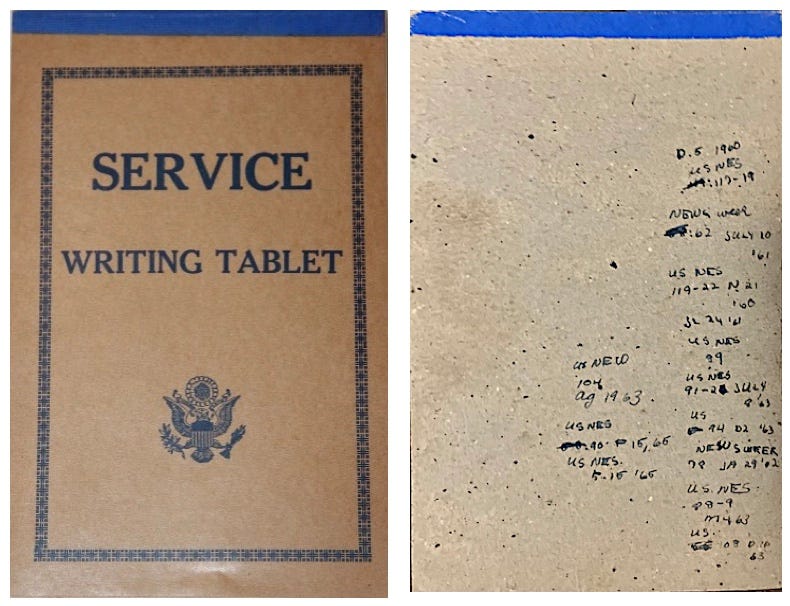
    There’s something about certain pads that have been around for a while that transcends the words written on them. My favorite is the “Service Writing Tablet” that soldiers were given during World War II to write letters home (and/or their last words). Fortunately, for my dad (and me), it was the former. He didn’t use those “tablets” much because, when his superiors found out he was an English Major, they handed him a typewriter so he could type grammatically correct reports for headquarters. It also made it possible for him to send legible letters home—many of which tried to set his family’s mind at ease by obscuring the fact that there was a war going on and he was closer to the front than he let on.

    Somehow I ended up with one of those “Service Writing Tablets”. I’ve torn out most of the pages over the years. But, on the rough cardboard-like back, there are scribbled references for some high-school term paper that I wrote—undoubtedly while standing over a huge oak card catalog in the library.

    I can still see…it’s more a feeling…the kid who wrote those notes fifty years ago. The words may now be irrelevant, but the synesthetic memories buried in that pad say a lot more than those words ever did.